“I became a homeless [sic] on December 29th, 2021,” Waris explained.1 Waris became homeless following an eviction by a private landlord, after which she, along with her husband and six children, was placed in a hotel by the City Council. When Waris refers to herself as “a homeless,” she does not mean that she is sleeping rough. Rather, for Waris and many Somali women in the U.K. Midlands city of Birmingham, homelessness is a protracted, existential condition that layers successive movements between hostels, hotels, and temporary houses in the British housing system with longer histories of displacement and seeking asylum.
566Before Waris and her family were evicted, she thought that she had finally found a safe place to live. “Although it was small,” she told us when we met her at a community center in Birmingham, “it had no damp. It was a beautiful home that I fixed up for us.” Yet in December 2021, her private landlord instructed her that he “needed his property back.” With private rents skyrocketing as the cost-of-living crisis deepened, Waris turned to the council housing department and was declared statutorily homeless. Her family was placed in two rooms in a budget hotel six miles away—distant from her children’s schools and the support of kin. The family remained there for a month. “There was no internet, no laundry facilities, nowhere to cook,” Waris recounted.
After this, Waris was moved to a temporary council house. Waris would wake up her daughter at 5 a.m. to take her to school. The long daily journey on multiple buses, and successive moves, worsened her youngest daughter’s learning disabilities. After teachers and doctors wrote to the council, Waris was moved again into another temporary house. She was told she could not view the house before relocation. “They said no, you don’t have a choice to take it or not.” This property had “heavy” doors; the walls were punctuated with signs declaring “no smoking” and “fire exit.” She explained, “I don’t think this house was intended to be a family home; it seems like it was built to be rented per room as offices or for single tenants.” After several weeks, mold began to creep through the property. Waris began to cough, and her children developed asthma and skin rashes. She explained, “The kids are sleeping on broken beds, and the mattresses are used, that’s why my kids’ skin is like this. My daughter layers so many blankets—if you were to see it, your body would reject it, it’s so dirty and stained.”
Waris tried in vain to contact the landlord and council housing officers—her calls were all ignored. “It’s like [the council] just threw us away.” Like many Somali mothers, Waris sees her greatest responsibility as the provision of a safe home for her children, free of the instability and overcrowding that she remembers from her childhood as a refugee. Yet this responsibility is stymied by the persistently precarious conditions of housing on both the private rental and social housing markets. “I feel like I’m being punished,” Waris told us. “They brought me here like a prisoner for seeking help.” Waris felt that, even though she was settled permanently in the United Kingdom, she was still considered a refugee.
Expanding Refugeetude
When does a refugee stop being a refugee? Legally, the period within which a person is considered a refugee is temporally short and spatially located—“an aberration in the otherwise consistent experience of nationality and 567political rights,” Vinh Nguyen (2019, 112) writes, that ends when a person leaves the boat, camp, or detention center, and “indefinite leave to remain” or citizenship is granted. Reflecting on the experiences of Vietnamese refugees in the United States, Nguyen argues that the experience of being a refugee extends well beyond the point of arrival or the granting of citizenship. In the context of economic insecurity and racialized inequality in host countries, refugeeness is not spatially or temporally exceptional (Cabot and Ramsay 2021; Ramsay 2017), framed either by the “eventfulness” and immanence of refugee crisis (Roitman 2013), the stuckness of exile (Brun 2016), or the protracted waithood of resettlement (Hage 2009). Instead, Nguyen (2019, 114) suggests, to be a refugee is a subjectivity—“an experience, consciousness, and knowledge that lingers even when the legal designation is lifted or one that might be present before the designation comes into effect” (see also Nguyen 2023). Highlighting its political potential, he calls this subjectivity “refugeetude,” indicating in the use of the suffix -ude that it is not a “stable internal identity,” but a consciousness of the “social, political, and historical forces that situate refugee subjects and the acts that attempt to know, impact, and transcend this situation” (Nguyen 2019, 118–19).
For Somali women like Waris, the persistence of refugee subjectivity manifested in encounters with insecure housing. Their use of the term homeless—often using the indefinite article (“I am a homeless”)—diverged from representations of homelessness as rough sleeping or couch surfing. Emic articulations of homelessness spoke to a condition of protracted displacement that Somalis have experienced, beginning long before the present housing crisis and uncontained by the legal temporality or spatiality of refugee status. A decade after arrival, Somali women were cycling through different forms of temporary accommodation not fit for their needs. This experience of homelessness is underpinned by a longer history of displacement, wherein the U.K. Somali diaspora have undergone multiple transnational migrations within Africa, the Middle East, and Europe since the Somali civil war of the 1980s and 1990s. Their inability to claim adequate state housing benefits, or rent adequate private housing, prevents them from experiencing the security of British citizenship or permanent residency. Displacement has reconfigured their relationships with home—as a memory, a present materiality, and a future aspiration—forestalling their efforts at homemaking and rendering their homes “permanently temporary” (Brun and Fábos 2015).
This essay investigates the emic use of the term a homeless as a form of subjectivity. It questions how this subjectivity is formed in relation to a state that has failed to provide Somali people with the full benefits of their citizenship in safe and stable housing. We find Nguyen’s concept of refugeetude helpful here for two 568reasons. First, it highlights how the temporality and spatiality of refugee subjectivity is not contained by the event of arrival. Second, it shows that consciousness of the conditions that generate persistent precarity for refugees provides a source of political agency. We also build on Nguyen’s concept in two ways. First, we examine its character beyond the extended refugee experience within North American racial capitalism. We wish neither to abstract and essentialize refugeetude as a form of universal refugee subjecthood, nor to find an example across the pond. Instead, we empirically trace how Somali women theorize the temporal and spatial experiences of refugee subjectivity. We contextualize the Somali diasporic experience in a longer history of racialized welfare policy in Britain as it is underpinned by logics of deservingness. We locate the kind of political agency experienced by Somali women as a product of their refugee subjectivity, not as the autonomous action of the liberal subject, or as Saba Mahmood (2006, 33–34) puts it, “not as a synonym for resistance to relations of domination but as a capacity for action.”
Second, we focus on the psychic dimensions—the “inner life processes and affective states” (Biehl and Moran-Thomas 2009)—of refugeetude. The psychic experience of displacement has been largely understood through the psychiatric paradigm of post-traumatic stress disorder (PTSD). We extend Nguyen’s line of questioning to ask: When does refugee trauma stop being refugee trauma? The exceptionalism of refugee time is replicated in refugee trauma—usually understood in linear relation to a past violence, underwriting the possibility of psychic harm being rendered through the discriminatory socio-political structures of the state (Çağlar and Schiller 2021). Yet, as Didier Fassin (2008, 533) points out, “trauma is not only a clinical description of a psychological status, but also the political expression of a state of the world.” Careful attention to emic expressions of homelessness challenges the temporal and spatial exceptionalism of trauma, as well as its implicit “epistemic coloniality” (Caple James 2016). This essay eschews the linearity of the trauma paradigm by attending to the multiple distortions of timespace that constitute refugee subjectivities—what Jess Cooper (2018) calls the “unfixing” of the subject in space and time. It shows that the events that unfix the subject and generate distress are not always those of extreme violence, but often those associated with everyday violence and brutality at the level of the family or household (see Panter-Brick et al. 2018). Attention to such events also allows us to trace the ways in which the political agency that Nguyen references is not always direct activism, but might involve the manipulation of time and space in creative forms of “arrangement and orchestration” (Ahmann 2018) to find reprieve from, or repair, such distortions.
569To probe the psychic dimensions of refugee subjectivity, we combined anthropological and psychotherapeutic methods to create spaces through which women could both consciously reflect on their experiences of displacement and express experiences latent or marginal to their conscious life (see Gammeltoft 2016). We paid particular attention to the multiple and sometimes conflicting ways in which women represented the temporal and spatial dimensions, or “chronotopes” (Bear 2014), of their post-arrival experiences. In what follows, we present three chronotopes—displacement déjà vu, uncanny domestic time, and the scared time of qaddarka (fate, destiny).
Our ethnographic insights offer an emic theory of refugeetude that renders visible the enduring psychic precarity of racialized citizenship in post-colonial Britain. This theory responds to recent calls for the inclusion of homeless people’s voices and ideas in public debate, historical memory, and academic scholarship (Speer 2021). We join such approaches in decentering the stigmatizing archetypal homeless figure—the male, rough-sleeping substance abuser adapting to life on the streets and in shelters in conversations around homelessness.2 Indeed, Somali women’s own narratives suggest that to be “a homeless” is much more than the absence of a stable house; it is also about the poor conditions of the house, their physical and psychic effects on those who live in them, and the cumulative experiences of constant movement and past displacement. This case resonates with others that figure homelessness not as the absence of a material house (Blunt, Ebbensgaard, and Sheringham 2021) but as a form of psychic suffering that expands across space and time.
A Hostile Environment
Recent scholarship from U.S. cities has shown that evictions lie at the core of financialized housing regimes (Desmond 2016; Stout 2019) and accrue disproportionately to minoritized groups (Rutan and Desmond 2021). In the United Kingdom since the Second World War, the white post-industrial urban poor were previously shielded from the sharp edge of financialized property accumulation through the state provision of social housing. Yet for diasporic groups from the outposts of the British Empire—Afro-Caribbean and South Asian communities—state provision fluctuated between conditional exclusions based on residency requirements and, later, offers of substandard accommodation in aging buildings (Rex and Moore 1967; Henderson and Karn 1984). A compounding with labor-market exclusion left postcolonial citizens to inhabit urban zones characterized by poor-quality housing throughout the 1960s and 1970s. Following 570repeated rounds of financial austerity since the 1980s, as well as the introduction of legislation that afforded tenants the right to buy their state-owned property, the vestiges of state housing provisioning have been stripped away for all (Koch 2018). The result is a wider national context in which increasing uncertainty in capital accumulation drives a speculative rentier housing economy and stokes xenophobic fears that intensify existing racial inequalities (Clare et al. 2022). In the private housing market, the hollowing out of local-authority enforcement agencies has seen private landlords’ poor behavior go unchecked and has diluted tenants’ political agency. The dearth of available social housing has driven local authorities’ increasing use of temporary accommodation in hotels, hostels, and poorly maintained state-owned housing (Nowicki 2023). Oftentimes these housing policies for U.K. citizens resemble the carceral detention policies imposed on asylum seekers—where, often, refugees and those in temporary accommodation are housed in the same privately run hostel or hotel and are subject to the same processes of dispersal away from their social networks (Darling 2022). The effects of recent reforms in the Renter’s Rights Act 2026—the promise of stronger landlord accountability for repairs and, notably, prevention of no-fault evictions—remain to be seen (see Storer, Simpson, and Duale 2025).
Against this wider policy nexus, racialized and Islamic groups including Somalis are framed as “undeserving poor” in ways that echo British imperial racial bordering policies (Ali 2023). Indeed, the Somali diasporic experience in the United Kingdom has been characterized by racial discrimination in access to housing since colonial times. Somali sultanates were colonized by Italian and British powers in the latter part of the nineteenth century, despite being met by fierce resistance movements. Land was partitioned between southern Italian Somalia and northern British Somaliland. These areas were merged to form the Somali Republic in 1960—whose political power was dominated by southern clans, causing the fractious clan tensions that would eventually fuel the civil war.3
Throughout the colonial and postcolonial periods, Somali immigrants came to the United Kingdom as seafarers who tended to settle in port cities like Cardiff, Liverpool, and London’s East End—experiencing suboptimal provisioning and displacement as a result of race riots (Harris 2004). Following the outbreak of Somali civil war in the 1980s, the population of Somali migrants dramatically increased, with refugees seeking state-provided housing on receiving asylum—through temporary status that had to be continuously renewed—by the New Labour government.4 Since 2010, new waves of Somali migrants comprise those who were originally granted refugee status in Europe and have come to the 571United Kingdom seeking a domicile where they could freely practice their religion and send their children to English-medium schools. After Brexit in 2020, these migrants have been granted indefinite leave to remain. Many have settled in Birmingham, where between 2011 and 2021, the Somali population increased by at least 39.2 percent.5
Yet wider encounters between the Somali diaspora and the British welfare state have become deeply fraught (Liberatore 2017, 2018). Social infrastructures set up by early Somali immigrants to support the diaspora have not translated into forms of political representation in local or national government (Kleist 2008). In the present, the Somali diaspora sits at the fulcrum of two policy approaches that the U.K. conservative government has implemented since 2012. On the one hand, an imposed financial austerity on local authorities, forcing them to slash budgets for social welfare, including housing, which has resulted in a plethora of intersecting issues related to health, unemployment, substance abuse, and poverty (Ermansons 2022). On the other hand, the increasingly muscular bordering policies of the Home Office’s so-called Hostile Environment approach, designed to make conditions of life—including accessing social housing, the right to rent, statutory healthcare, and the right to work—so difficult for migrants and refugees that they voluntarily leave. Following Brexit, which both stoked xenophobic fears and rendered the settled status of many migrants insecure, the country has witnessed a creep in the application of such Hostile Environment policies to racialized migrant groups who have “leave to remain” or even British citizenship. These restrictions have been particularly experienced in the screening of citizenship status through so-called right-to-rent checks as a prerequisite to renting houses. The ripple effects of this legislation have allowed landlords to opt out of renting to non-white tenants, like Somalis, altogether.
A Counter-Investigation
The bustling high street of Raun Hill lies in the historically deprived Eastern ring of Birmingham. It acts as an economic hub for Somali, Syrian, and Yemeni people who have come to settle there over the past decade, seeking cheap rents, proximity to mosques, and kinship connections. However, commercial and residential property in this ward (the smallest administrative unit of U.K. governance) is largely owned by British Asian landlords who arrived in the United Kingdom from Commonwealth countries following colonial recruitment to Birmingham factories in the 1950s and the expulsion of Asians from East Africa in the 1970s. Originally housed in substandard Victorian and interwar private 572rentals in the Eastern Corridor, British Asians later purchased residential stock, which they now let to newer migrant groups (Bhachu 1986; Burholt, Wenger, and Shah 2002). While Birmingham’s multicultural heritage is publicly celebrated, racialized groups remain disproportionately housed in substandard dwellings of the inner city. These are spaces punctuated by the main arterial roads leading from the city, where residents breathe poor-quality air (Noxolo 2025) and where health services are inadequately equipped to handle residents’ needs.
Suad Duale, an activist and counselling psychologist who hails from this community, first brought Nikita Simpson to Raun Hill during the COVID-19 pandemic. They had developed a research collaboration through their participation in the LSE Covid and Care Research Group, led by the anthropologist Laura Bear, which aimed to embed ethnographic insights in COVID-19 policy-making processes. COVID-19 had caused overwhelming mortality in Birmingham’s Somali community, partly due to overcrowded housing. Simpson and Duale documented these experiences in a short film—the culmination of two years of ethnographic research on the legacies of stigma generated by the pandemic (see Bear et al. 2021). In the summer of 2021, we returned to screen the film to a group of thirty Somali women. As the film concluded, Duale asked, “What should we do next?” “Housing!” one woman cried. A chorus echoed this call. “Yes, I am a homeless.” By the end of the session, more than ten women had come to us to tell us that they were “a homeless.”
We returned to meet these women at the coffee morning of the community center for Somali women—inviting Elizabeth Storer to join us and bring her expertise in health geography.6 The women shared information about our study with their friends and kin via WhatsApp. The emphasis on housing insecurity was collective and consistent, despite numerous differences in their positionalities. The women we encountered ranged in age between twenty and forty-five, though some were accompanied by elderly mothers and many brought toddlers and young children. Some women were employed in part-time roles such as care workers, teaching assistants, or ran their own small businesses like clothes shops or catering services. They had different educational backgrounds—some had post-secondary degrees, while others struggled to read and write, or to speak English. Most had indefinite leave to remain in the United Kingdom or British citizenship but were born in Somalia and raised along transnational networks of kin in Africa and Europe. Many did not know their biological parents but remained connected to large networks of kin through telecommunications and remittances (see Carver 2021). In the United Kingdom, women spoke of supportive relations with adopted and real kin, especially with sisters. All women 573were or had been married, but conjugal forms varied. While some lived with their husbands in the United Kingdom, many had husbands living in other countries, meaning they were the sole carers for children and responsible for housing. Many were divorced single parents, and some were in what they called “part-time marriages”—implying conjugal intimacy and legal obligation but without live-in husbands who might help care for children. The women’s experiences resonated with studies of changing kinship and marriage structures in the Somali diaspora—where a male loss of status precipitates marital stress, domestic violence, divorce, and a desire to return to their homelands, leaving women to build lives in the diaspora (Carver 2021, 17; Liberatore 2018). It was striking that the problem of homelessness characterized the experience of this racialized group across distinctions of class, migration history, and age—revealing the structural racism embedded within systems of housing allocation.
Encountering these women, we were drawn into a “counter-investigation” (Fassin 2021) to document the shape of homelessness in this community.7 Through the utterance, “I am a homeless,” women articulated material deprivation, political abandonment, existential insecurity, and ongoing psychological distress. To glean these multiple meanings, it proved necessary to layer multiple methods from anthropology and psychology.
First, we collected about thirty-five “housing biographies” (Althaus and Glaser 2014) with women who came forward. Duale conducted these interviews with either Simpson or Storer—each drawing on their methodological training to ask specific questions. Women adopted a testimonial form, relaying the circumstances of their homelessness in forensic detail, punctuated by dates and times of evictions, and sometimes offering evidence in the form of Section 21 eviction notices, letters from landlords and doctors, and images of deteriorating homes. While these testimonies resembled accepted forms of witnessing in Islamic juridical practice, narratives were equally shaped by the legal genre necessitated in British and European asylum and housing systems. Multiple encounters with debt, housing, and legal advisors limited testimonies into the bureaucratic categories used by the state as a prerequisite to obtain asylum or housing. They also involved notable omissions—women did not talk about their husbands, any of their male kin, their caste or class positionality in the United Kingdom or Somalia. These omissions proved important, as they worked to shape the self-representation of women vis-à-vis the welfare state.
We recognized that women’s political claims, when made to us, were misdirected. While we could leverage our privileged positions to advocate for their interests, provide information, or connect them to legal aid, we could not ultimately change their material realities. We could, however, thanks to Duale, offer 574psychotherapeutic techniques for holding the psychological space for their distress. In four workshops held at the community center, we used creative methods—mapping, painting, dance, song, poetry, and drama—to allow the women to share their experiences of homelessness. These workshops offered sites of ethnographic engagement, but they also served as spaces of relationality (Degarrod 2016) that allowed women to remember and represent past homes, and to imagine future homes for themselves and their children in ways uncontained by modes of state spatio-temporal control. These manifold representations of home yielded a rich symbolic language through which women expressed their experience of homelessness and allowed us insight into the psychic resonances that exceeded their testimonies. Critically, these workshops offered insight into experiences suppressed or marginal to conscious life—the “secret, the hidden, the unspoken, and the unspeakable as qualities of subjectivity” (Good 2012, 519). Together, we deployed both ethnographic and psychotherapeutic epistemologies to reflect on, analyze, and triangulate the different stories that our participants told us. Critically, Duale managed to contribute theological and cultural nuance to the analysis, as well as her own lived experience. Simpson was able to contribute an ethnographic sensibility, and Storer brought a scalar perspective—linking specific insights to broader histories and geographies of displacement in Birmingham.
Speech acts of telling distress involved forms of temporal and spatial labor whereby the women sought voice “both within and outside the genres that become available in the descent into the everyday” (Das 2007, 216). The genres that women drew on proved diverse—they compared Islamic theological concepts with state policy categories; they offered Somali cultural kinship idioms to 575describe encounters with local bureaucrats. The genres involved a strategic temporalization and spatialization of their experiences, invoking what Bear, drawing on Mikhail Bakhtin, calls “chronotopes” of their refugee experience to refuse its exceptionalism and to insist on the persistence of refugee trauma. As Bear (2014, 7) puts it, a chronotope is a representation that materializes timespace “in a manner than enables the dimension of time to become visible. They achieve this through thickening the dimension of time by a layering of the effects of images and narrative structures.” Scholars of diasporic experience have found that identifying and following chronotopes illuminates dimensions, or “frequencies,” of refugee or migrant experience that exceed the event of displacement, crossing or arrival, and are otherwise hidden or imperceptible (Campt 2017). As Charlotte Sanders (2019, 16) has found in making maps with Sudanese mothers in Portsmouth, allowing refugee women to represent alternative chronotopes offers insight into “multiplicities of positionality and subject-making.” Stefania Pandolfo (2007, 333) observes a similar braiding of genres in Moroccan migrant youth, suggesting this provided “the framework and ethical horizon within which subjectivity and despair, the de facto exclusion from citizenship, the experience of the end of social relations, are understood and originally reconfigured.” We watched as women presented three chronotopes that broadened the spatial and temporal horizons of their refugee experience.
Figure 1. Elizabeth Storer and a co-facilitator pin up participants’ paintings of home. Photo by Nikita Simpson.
Displacement Déjà Vu
As a single mother, Ayaan found the COVID-19 pandemic impossible, as she had to give up her job to take care of her children. Part of her struggle was that she had also brought her mother from Somalia to live with her. “It was also stressful having mum here,” Ayaan said. “We haven't seen each other for years. I've only met her once, many years ago. I’ve never really had a mum. I grew up in different families. So, I never actually had a home. And that’s why I'm so eager to protect mine. To make sure I have time for [my children].”
Ayaan was born in Somalia but was separated from her family for most of her childhood, cared for by relatives in Djibouti and Yemen. She came to Scandinavia as an asylum seeker in the 1990s and settled in the United Kingdom in 2000 when she found it difficult to practice her faith in her original European location. Since moving to Birmingham, Ayaan has been sending money back to her mother, but her main aim has been to provide a safe home for her own children. “I don’t even know half of my siblings,” she admitted. Ayaan went on:
576This is why family is important to me. I said, I will never bring my family up like this. I don't want them to be split up. There was no personal space [in my childhood homes], it was always just too many people, it was overcrowded. I always say to my mum, I don’t want to repeat the same thing as my ancestors, as all Somalis. But she says, what's the matter with that? Because she believes the pain [that] she’s gone through is worse, from the war. Hunger. Those sorts of things. So, what you have is nothing compared to what I have [had] to go through.
When Ayaan arrived in the United Kingdom, her aspiration was thwarted by her inability to secure a house. She felt frustrated by multiple evictions and moves between hostels and hotels. She framed this frustration not as an individual condition, but as one that marks the Somali diasporic experience. “They don’t give [Somali people] chances,” Ayaan told us.
They always see them as refugees. Just taking everything . . . . There’s the idea that they can’t prosper, no matter what. Because we’re always going to be refugees. We’re just always going to be takers.
Ayaan’s comments confirm anthropological accounts of Somali life highlighting that “the refugee experience has indelibly marked Somalis’ encounter of the West” (Berns McGown 1999, 14). While this experience is differentiated by specific migration histories, caste, and class positionalities, refugeeness issues a persistent and racializing stigma that clings to popular representations of Somali people in Britain (Liberatore 2017; Samanani 2014; Lewis 2021). In the present Hostile Environment policy approach, Somalis are framed as a “problem community”—recalcitrant to the logics of productive neoliberal citizenship, dependent on state benefits, and resistant to taxation (Liberatore 2018). For Ayaan, experiences of displacement and migration at the borders of Europe and the United Kingdom bleed into experiences of eviction and temporary accommodation. Such policies are entwined as mechanisms by which certain groups are “subjugated as threats to sovereignty even after, or as a result of, being provided with legal national identity” (Ramsay 2017, 517). At the fulcrum of these policies, the stigma and shame that issue from popular representations are used as tools to govern racialized groups (Tyler 2020).
However, in Ayaan’s statement that “we are always refugees,” this stigma is turned on its head. Instead of internalizing such stigma, Ayaan’s temporalization 577of persistent refugee subjectivity works to push responsibility back onto a state that ought to provide for its citizens. In doing so, she connects her present experiences of precarity with a much longer colonial history of displacement and invokes a recursive chronotope—where her present situation constitutes a new iteration of prior displacements and intergenerational experiences of colonial dispossession.
Ayaan’s insistence on the persistent temporality of displacement was echoed in symbolic representations of home that women painted during the creative workshops. Asked to paint any home where they felt safe, almost all participants painted a home in Somalia. They explained that these houses featured large courtyards, open doors where kin would visit, and beds with many sleeping children. They compared these to the temporary houses they were currently living in—with restricted space for sleeping or sociality that prevented women from being able to host kin or visitors. Participants made direct links between the original displacement from their home and present displacement. Some even made direct links to the persistent coloniality of housing provisioning and welfare policies. “The very [architecture of the] house is colonial,” one participant suggested; “they are trying to stop us from having children or meeting our families.”
In women’s narratives, eviction was the site at which this recursive temporality crystallized. The women did not experience eviction as a singular event beyond the normal flow of life; rather, they saw it as a further iteration of an infinite number of events that had occurred before and would occur again. As private tenants, women would be given a Section 21 eviction notice, and told that their landlord’s “son is getting married.” While these evictions were lawful, many women resisted them for their arbitrariness. The women sought other 578housing on both the private market and through the council, but wait times were long and negotiations with private landlords arduous. If they failed to leave the house, many recounted, they faced forceful removal with their children and belongings, or found themselves returning to a house with the locks changed. Evictions by private landlords are the leading cause of homelessness in the United Kingdom. On eviction, the Housing (Homeless Person) Act of 1977 rules that local authorities in the country are legally required to offer housing to those who now find themselves homeless. The act, which sets out a legal definition of homelessness and priority need, requires those seeking housing support to prove that they warrant state assistance. Those evicted often enter into a cycle of temporary accommodations and a moral economy of advice whereby they have to stretch and shape their lives to fit state categories of deservingness (Wilde 2022; Alexander, Bruun, and Koch 2018). As Idil, another Somali mother, recounted:
Figure 2. A home drawn by a participant, in Somalia. Photo by Nikita Simpson.
Figure 3. A home drawn by a participant, in Somalia. Photo by Nikita Simpson.
I became homeless again because the landlord of the house I’ve been living in for four years told me last year, around November 15th, that I have to leave the house. On March 15th, he came to the house when I left with the 579kids to take them to school . . . he put all our clothes in bags and put our TV outside and locked the door.
When families are evicted, they often call on kin for support or shelter. Yet the poor quality of housing stock and overcrowding make this an unfeasible long-term arrangement. Soon, families again feel the pressure to move on.
In eviction, Erik Harms (2013) suggests, time becomes estranged in ways not captured by the act of concrete displacement in space. Evictions for Somali mothers are not experienced as a singular temporal and spatial rupture, nor only as a state of waiting for a home. The chronotope of eviction is thick and layered, as if in a state of déjà vu. This déjà vu proved painful, but it did not render women passive. Instead, as Harms (2013, 347) puts it, watching time in eviction situations “affords a view into more subtle and ambiguous forms of contested action that might not otherwise appear in a search for more overt, politically dangerous, forms of collective action.” Women’s refusal to leave housing, their insistence on state responsibility to provide alternatives, and the connections they were making between evictions in the present and the past all provide examples of strength and agency. Representing time as recursive explodes the temporal exceptionalism of refugee subjecthood, as well as the temporal linearity of trauma. This chronotope turns hegemonic representations of Somali people as undeserving of state welfare inside out by bringing longer histories of violence to bear on the present hostile environment. In this, women insist on state culpability for their marginal positionalities, call out intergenerational racism in housing provisioning, and strategically make a claim on a state welfare system that has excluded them.
Uncanny Domestic Time
Between evictions, women attempted to build stable domestic rhythms—cooking, cleaning, homework—to structure their children’s lives and avoid state child removal. These social reproductive labors were continually ruptured by the temporariness of their homes. Mona reflected on her experience of staying in a hotel:
We didn’t have somewhere to cook. . . . There were eight of us in two rooms. . . . Three boys and their dad would sleep in one room, while my two daughters, my little boy, and I would sleep in one room. . . . My daughter studies in Year 11, and at that time had exams, so we had to take a taxi to attend her exams. It would cost me sixty-two pounds.
580These disrupted domestic rhythms were experienced most acutely by those living in temporary accommodation hostels or hotels. Temporary accommodation often turns out to be far from a temporary arrangement (Garvie et al. 2023). Most households have lived there for a year or more. Many are forced to leave at short notice, staying in a string of places for short periods, unable to bring possessions. Often these dwellings were located outside the family’s regular neighborhood—women were cut off from kin and had to take long bus or expensive taxi journeys to get their children to school. Dwellings were fitted with regulatory strappings—exit signs, fire doors, safety notices—that could not be changed and therefore served as a constant reminder of the state’s presence in the home (Harris, Brickell, and Nowicki 2020). Many of these locations were in 581states of extreme disrepair. Appliances or heating did not work, electricity lines were left exposed to water, homes were infested with vermin, and rooms were exposed to extreme mold and damp.
Figure 4. Mold growing in the kitchen of a council-owned temporary accommodation house inhabited by a Somali woman and her family. Photo by Nikita Simpson.
The experience of living in temporary accommodation rendered domestic time uncanny. The uncanny in German is unheimlich—derived from the German word Heim, meaning “home”—which Sigmund Freud (1919, 2) defines as that which is “friendly, homelike, arousing a peaceful pleasure and security as one does within the four walls of his house.” Freud (1919, 4) shows how the quality of this word “develops toward an ambivalence until it finally coincides with its opposite, unheimlich.” For the women we encountered, domestic time appeared uncanny in that any sense of present or future security remained illusory and was continually ruptured by horrifying presences: the continual intrusion of the state in visits from housing officers, landlords, or mold that “invaded” the home. These invasions also proved temporal—the invasions of experiences of trauma into the present, such that the house became an “unhomely” place. As Homi Bhabha (1992, 141) writes: “The intimate recesses of the domestic space become sites for history’s most intricate invasions. In that displacement the border between home and world becomes confused; and, uncannily, the private the public become part of each other.”
Uncanny domestic time also crystallized in the experience of the online housing bidding system. In Birmingham, the housing list is a faceless online system, where women must bid for houses which are allocated based on the state’s determination of their relative vulnerability. To be classified as highly vulnerable, women recounted hostile encounters with housing officers who visited to assess their citizenship status and living conditions. The women experienced these interruptions as terrifying intrusions of the state into their domestic space. Houses were released onto the bidding system in the middle of the night, such that most women set an alarm to wake up. Many told stories of being notified that they were first on the list, only to turn up at an inspection for a house that had already been given away to someone else. The appearance and disappearance of housing seems ghostly to many of those seeking it. As Axmed put it, after being notified that she was number one on the bidding system—“it was like a ghost, the address and the house just disappeared out the system.” Women experience both the digital platform of governance and the wider psychic experience of the state as opaque. Some argued that processes of housing allocation are racialized, such that Somali names are immediately struck off or housing officers allocate stock to those from their own communities.582
Uncanny domestic time reveals important links between domestic experiences and nationalist notions of belonging in the British post-colony (Bear 2007), where racialized regimes of citizenship are sustained through the management of social reproduction (Stoler 1989). In the post-colony, such racialized regimes of citizenship are not suspended, but take on new casts through the management of domestic practices, including housing, child-rearing, health care, hygiene, and sexual intimacy. Migrants and refugees often find themselves the target of such intimate interventions because they not only breech borders but also present a problem of futurity (Ramsay 2022). As such, the refugee house becomes a site of sovereignty, and such sovereignty works through the affect of shame.
For Somali women, to be a mother, and to build home, functions a source of respect, merit, and joy. Women saw their primary responsibility to their children, and the flourishing of their children as a source of pride and wealth—“a woman who sees her life’s work primarily as the raising of her children still has her raison d’être as long as those children are with her,” Berns McGown (1999, 14) writes. If she is unable to provide a home for their children, or if her children are removed by the state, this is a source of shame. Such responsibility is 583complicated by generational divides in expectations of motherhood and homebuilding. Many Somali women have not experienced stable childhoods and don’t know their own biological mothers (see Carver 2021). This opens an affective and experiential gap between Somali women and their mothers. Instead of being able to transmit intimate, quotidian knowledge about child-rearing and care, some see their own mothers as unable to appreciate the violence of resettlement, having been through the direct violence of war and displacement while they themselves were young mothers. Recall what Ayaan told us: “I’ve never really had a mum. . . . I never actually had a home. And that's why I’m so eager to protect mine.”
Many women experienced the state lack of housing as a disciplining of mothering. Preventing women from being able to build a home was a recursive rearticulation of the trauma in their own childhoods. Crucially, many saw the building of such a home as a way of stopping time and the transmission of distress and displacement to future generations. The affective experience of this temporal impasse was marked by intergenerational shame vis-à-vis the experience of their mothers.
Qaddarka
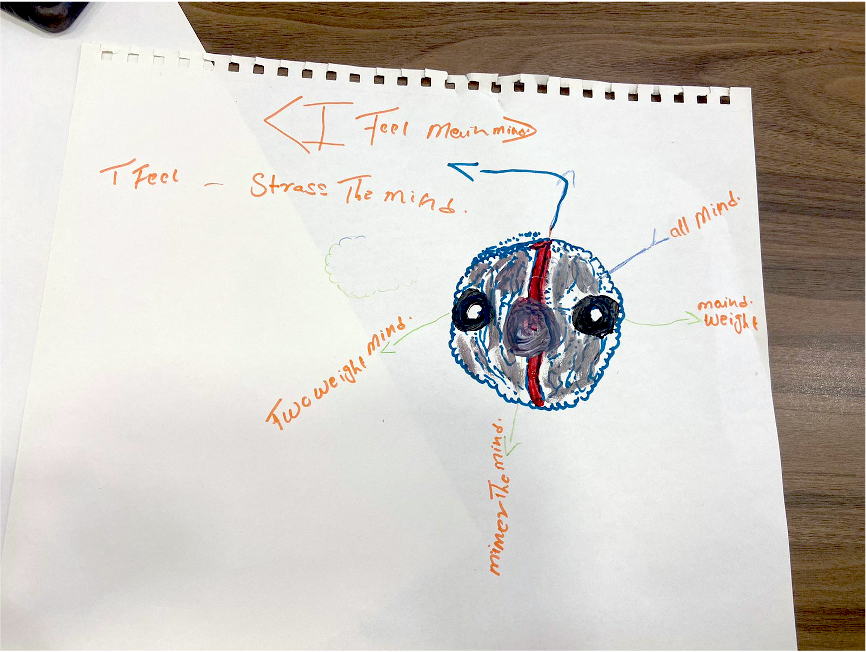
When the shame became overwhelming, women’s experiences of time would become estranged to a point of distress. This distress ran along the grooves of the jerky temporalities set by housing officers, social workers, private landlords, and a faceless digital bidding system, but it also breached their bodies and minds. Almost all the women we met mentioned that they had experienced distress because of their housing situation, expressed as a deceleration or cessation of domestic rhythms sustained by their labor. Many mentioned that they found it hard to get up in the mornings, that they couldn’t eat or sleep because their head was “too full.” Others complained of physical ailments—asthma, aching joints—that they attributed to their living conditions. However, they were most concerned for their children’s health. All those living in conditions of disrepair mentioned the acute asthma, skin issues, and blisters that their children experienced, multiple trips to the hospital, and the children’s social withdrawal.
However, women made precise distinctions between distress caused by an unjust state and distress that could be reconciled as qaddarka—destiny. Consider the following interview:
Duale: What do you think is the reason why you are still waiting for a permanent house for seven years?584
Figure 6. A Somali woman draws her stress. Photo by Suad Duale.
Khadija: Only qaddarka [fate, destiny]. Well, I believe I will only get the house that is written for me.
Duale: Any other reasons?
Khadija: I do my best and call them, but nothing. You don’t know what requirements I am missing . . . so I don’t know, God’s decree.
The chronotope that Somali women are drawing on in qaddarka is Qur’anic, where the term is rooted in the Arabic qadr (قدر). Notably, the Laylat al-Qadr is celebrated as the “night of power,” on which Muslims believe the Qur’an was first set down or revealed. As Geoffrey Hughes (2023, 13) recounts, “the Quran can be found on a ‘well-preserved tablet’ alongside ‘a complete description of every real and possible determination (qadr) of everything that will be, or could have been, created,’ reflecting, but also standing outside of human Time” (see also Mol 2017, 76–77). Centuries-long philosophical and theological debate surrounds the question of how qadr might be understood as a moral precept between the poles of tawakkul (utter reliance on God’s will) and sa’i (acting in this world); between irada (human agency) and qadar Allah (the predestination of God’s ultimate will) (Hamdy 2009, 192). Anthropologists of Islam have argued that qadr should not be understood as an Orientalist or anti-scientific fatalism (Hamdy 2009), but, rather, as a relational orientation of openness and receptivity toward a supreme agency (Schielke 2019; Elliott and Menin 2018). Scholars have traced the conditions under which the subject cultivates submission to God’s decree through pious practices that issue affects like sabar (patience, 585perseverance) (see Mahmood 2004; Qureshi 2013), and the instances in which they are acted on by God’s will through vehicles such as dreams or visions (Mittermeier 2012). Critically, both orientations—cultivating submission and being acted on—are not passive forms of structural determinism, false consciousness, or cruel optimism, but agentive means of acting in and on the world.
Somali women act on their situation by making careful distinctions between the elements of their suffering that are predetermined by God and those that result from an unjust British state. These distinctions occur against wider imaginaries where Somali diasporic women “premise their belonging to an imagined global religious and reformist ummah over that of an ethnic or national culture” (Carver 2021, 3). The use of qaddarka indicates that their present experience of homelessness, as well as the Somali diasporic experience of racialized marginalization, are conditions they must accept as God’s will. In framing these generalized conditions as qaddarka, Somali women indicate the ways in which, as Mittermeier (2012, 256) describes, their lives are “intertwined with and invested in networks of relationships ‘between heaven and earth,’ between the visible and the invisible . . . subjected to structures of power, to society . . . but also to otherworldly realms.” These experiences are distressing, but they are collective rather than individual. Thus, they ought not be a source of shame or self-blame. By contrast, the actions of other individuals, such as housing officers and landlords, are not sacred, but human, and thus not the will of God. Such actions warrant critique and retribution. Axmed expressed this idea most clearly:
I feel it is my destiny [qaddarka] where I am placed, but I think that Birmingham City Council . . . might not be aware of how we live . . . there is a lot of corruption. I am not blaming the Council but the workers who are not bothered [to] come or see where they are placing the people. They need to come and check, and we don’t know who to complain to.
As Pandolfo (2007, 334) also observed, the invocation of theological concepts in the “shifting realm of . . . conversations” allowed Moroccan migrants not only to accept their situation but to “carve a possible critical space, by drawing on vocabularies and looking for answers in the Islamic tradition.” Similarly, the invocation of the broader temporal horizon of qaddarka, and its comparative assessment with state bureaucratic processes, indicated a political consciousness of the refugee condition—the -ude that Nguyen speaks of. It involved a sense of resignation: for those who are not awarded the full dignities of citizenship, who 586are excluded from national flourishing by a hostile environment, there will not be change. Instead of such resignation driving disassociation from the state, it initiated a dogged insistence on the part of Somali women that they deserve a home—not in spite of their racial position and entanglements in colonial history, but because of it.
Attending to the Distress that Policies Generate
In Frantz Fanon’s The Wretched of the Earth, he speaks of the colonial struggle as a struggle over time. “The problem considered here,” Fanon (2001, 53) writes, “is one of time.”
Those Negroes and white men will be disalienated who refuse to let themselves be sealed away in the materialized Tower of the Past. For many other Negroes, in other ways, disalienation will come into being through their refusal to accept the present as definitive.
To be oppressed by the colonizer, then, is to be fixed in time, and to have the possibility of history and futurity stripped away. This fixity is experienced in the mind and body as distress, condensed as tensed muscles or psychological disorders (see Scott 2010, 40). To overcome such oppression, to throw off the yoke of coloniality, means to restore or resurrect time. This process is not only the restoration of the history of the oppressed, but the living of time, its daily remaking.
For Somali women, making home constituted an act of restoring timespace. In these three chronotopes, we can observe the constant, daily struggle through which Somali women are remaking timespace to resist the fixity of the refugee slot. Somali women experience eviction as déjà vu—eliding the present with histories of displacement. They push against the horizons of the present to render visible the ways in which the distress caused by upheaval refracts through their everyday encounters with the state in ways that parallel or even replicate the distress caused by colonial dispossession. They strive to stop this distress from transmitting to the next generation through their homemaking practices. State intrusion ruptures this attempt, rendering the home uncanny. Such uncanny forces stymie homemaking projects and curtail the possibility of futurity for them and their children—eliciting shame that they cannot perform their primary moral duty as mothers. However, such shame does not render them passive. Instead, they make precise distinctions between that which is sacredly decreed, which they must accept, and that which is caused by a state that continues to dispossess them and must be fought.
587Through these representations of timespace, Somali women exercise the political consciousness of a refugee subjectivity that is not defined by state bureaucratic categories. Paying attention to this labor of timespace offers insight into the everyday ethical “fact of struggling, and creating oneself, with and against the limits of one’s cultural universe” (Pandolfo 2007, 334). To be “a homeless,” then, describes a refugee subjectivity, shaped by lifetimes and generations of displacement set within wider conditions of existential uncertainty that pervade Somali diasporic life. To be “a homeless” also describes a political consciousness of this condition, a claim against a postcolonial state that continues to dispossess.
What does “a homeless” tell us about what it is to live as a postcolonial subject in late liberal Britain, or elsewhere? While the historical specificity of this condition ought not to be bloated, this case shows us that distress is not just a collateral of late liberal policy—it is its objective. Anxiety, as Ann-Marie Fortier (2017, 8) puts it, “is an enduring feature of the state-citizen relationship” (also see Lea 2024). The question of whose anxiety or distress is acknowledged and alleviated by housing, migration or health policy, and who has to absorb distress caused by such policy, generates and perpetuates inequality. Usually, policies designed to generate distress are applied to groups beyond the citizenry, to migrant groups, as forms of bordering. The hostile environment policy offers one example of this—designed as part of the bordering strategy of post-Brexit Britain to generate distress and exacerbate trauma for particular groups so as to reproduce structural hegemonies of race, class, and gender forged through colonial relations and persisting in the post-colony. To return to Bhabha (1992, 144): “The unhomely moment relates the traumatic ambivalences of a personal, psychic history to the wider disjunctions of political existence.”
However, insights in this essay show that policies designed to generate distress are being targeted at particular racialized groups within the citizenry—not in their direct ideological lilt but in the technologies and calculi used in their implementation. Even though housing is a statutory right in the United Kingdom, it is hard to access it in the web of digital bidding interfaces, conflicting advice agents, and blaming state officials. Making a claim to housing is near impossible and the object of immense distress. Other examples of such distress-generating policy exist in the United Kingdom: the PREVENT strategy that aimed to “safeguard” individuals from radicalization by entering and monitoring schools and places of worship; the COVID-19 social-distancing policies that disciplined and stigmatized communities or individuals who lived in intergenerational households, ran family businesses, or cared for dependents in ways that broke regulations. As Tess Lea (2024) observes, such distressing policies often target, and 588have historically targeted, the same groups, such that the present is experienced as “haunted” or “laden” with a range of state encounters that are uncaring, gaslighting, or disciplining. Referencing experiences of indigenous groups in Australia and Canada, Lea argues that such policies sculpt the embodied and affective experiences of the present for marginalized subjects.
We end with a call to deepen ethnographic attention to distress within policy ecologies, and to embolden our discipline in speaking with and back to policymakers and the dominant disciplines that generate the evidence guiding them. The cumulative and accretive nature of policy is invisible to scholars who begin their inquiry with the policy itself, rather than with the body and mind of the subject of that policy ecology. Following distress ethnographically as it circulates—at the macro-political level of policy edicts and ideologies (productivity, growth, equality), the meso-level of governance and bureaucracy (claims-making, needs assessment), and the micro-level of kinship and care—offers a fuller picture of how inequality is generated and perpetuated within policy ecologies.
Abstract
The city of Birmingham acts as a microcosm for the United Kingdom’s urban housing crisis, where hostile migration policies intersect with austerity-driven divestment in public housing stock to produce insecure provisioning for Birmingham's migrant and refugee communities. Birmingham’s Somali mothers are one collective who bear the brunt of this crisis in experiences of successive evictions and cycles through various forms of temporary accommodation hostels, hotels, and houses in disrepair. In this essay we listen to their testimonies of being “a homeless” [sic]. Listening reveals that homelessness makes for an emic articulation of an experience of recursive displacement that began long before the present housing crisis. “A homeless” marks a politicized refugee subjectivity that invokes multiple chronotopes of trauma, akin to what Vinh Nguyen has called refugeetude. Through this case we contribute to pressing conversations on the persistence of refugee subjectivities in postcolonial Britain and elsewhere by substantiating their psychic dimensions. We argue that attending to the distress that policies generate for marginalized groups is a critical contribution that anthropology can make. [housing; displacement; trauma; refugee; diaspora]
Notes
Acknowledgments The authors thank Ella Hubbard and Iona Gaskell for their contributions to this research project, Milena Weurth for formative research assistance and Geoffrey Hughes for advice on theological understandings of qadr. The authors disclose receipt of the following financial support for the research, authorship, and/or publication of this article: This research was funded through small grants from the SOAS IAA, CAMHRA Research Accelerator, and IKE Funds, the LSE Research and Impact Support Fund (108719), and the Centre for Public Authority and International Development (ES/P008038/1 and 589ES/W00786X/1). This research was approved by the SOAS Research Ethics Panel (412/NCCSHoMH/vREP0224), as well as the QMUL Research Ethics Panel (2035). This article was also enhanced through engagements with colleagues at the Ecole des Hautes Etudes en Science Sociales in a workshop organized by Richard Rechtman. It further benefited from presentations to colleagues at the Department of African Studies and the Anthropology Research Seminar at the University of Birmingham hosted by Anthony Pickles, the HOME Conference of the Science and Society Network at Deakin University hosted by Fiona Andrews and Emma Kowal, and at the CRASSH seminar at the University of Cambridge hosted by Kelly Fagan-Robinson. Primarily, this work is indebted to the women who shared their stories and to the community leaders who facilitated these exchanges, particularly Asha, Faiza, and Fadumo.
3. See I. M. Lewis 2002 and J. Lewis 2021 for deeper historical and historiographic accounts of Somalia’s colonial history and the history of the Somali diaspora in the United Kingdom.
4. Before 1990, most Somalis seeking asylum were granted refugee status and became citizens. However, those who arrived later were more likely to be granted temporary status, or indefinite leave to remain under the UNHCR Government Gateway Protection Program. This status had to be continually renewed, and this policy generated a material and existential sense of persistent temporariness (Carver 2021, 15).
6. This study was motivated by the obligation to relay stories of housing displacement, and hence has an activist orientation. As a result, it does not have the deep representation of Somali diasporic life, marriage, kinship, religion, and gender present in brilliant accounts by scholars like Natasha Carver (2021), Giulia Liberatore (2017, 2018), and Joanna Lewis (2021), to which we are indebted in our analysis.
Ahmann, Chloe2018 “‘It’s Exhausting to Create an Event Out of Nothing’: Slow Violence and the Manipulation of Time.” Cultural Anthropology 33, no. 1: 142–71. https://doi.org/10.14506/ca33.1.06
Alexander, Catherine, Maja Bruun, and Insa Koch2018 “Political Economy Comes Home: On the Moral Economies of Housing.” Critique of Anthropology 38, no. 2: 121–39. https://doi.org/10.1177/0308275X18758871
Ali, Nadya2023The Violence of Britishness: Racism, Borders, and the Conditions of Citizenship. London: Pluto Press.
Althaus, Eveline, and Marie Glaser2014 “House Biographies: Housing Studies on the Smallest Urban Scale.” In Cities for Smart Environmental and Energy Futures: Impacts on Architecture and Technology, edited by Stamatina Th. Rassia and Panos M. Pardalos, 283–90. London: Springer.
Bear, Laura2007 “Ruins and Ghosts: The Domestic Uncanny and the Materialization of Anglo-Indian Genealogies in Kharagpur.” In Ghosts of Memory: Essays on Remembrance and Relatedness, edited by Janet Carsten, 36–57. London: Blackwell.
Bear, Laura, Nikita Simpson, Caroline Bazambanza, Rebecca Bowers, Atiya Kamal, Anishka Gheewala Lohiya, Alice Pearson, Jordan Vieira, Connor Watt, and Milena Wuerth2021 “Social Infrastructures for the Post-Covid Recovery in the UK.” Report. London: London School of Economics and Political Science, Covid and Care Research Group.
Berns McGowan, Rima1999Muslims in the Diaspora: The Somali Communities of London and Toronto. Toronto: University of Toronto Press.
Bhachu, Parminder1986 “The East African Sikh Diaspora.” In The Sikh Diaspora: Migration and the Experience beyond Punjab, edited by Gerald Barrier and Verne Dusenbery, 235–60. Delhi: Chanakya Publications.
Blunt, Alison, Casper Laing Ebbensgaard, and Olivia Sheringham2021 “The ‘Living of Time’: Entangled Temporalities of Home and the City.” Transactions of the Institute of British Geographers 46, no. 1: 149–62. https://doi.org/10.1111/tran.12405
Brun, Cathrine2016 “There Is No Future in Humanitarianism: Emergency, Temporality, and Protracted Displacement.” History and Anthropology 27, no. 4: 393–410. https://doi.org/10.1080/02757206.2016.1207637
Brun, Cathrine, and Anita Fábos2015 “Making Homes in Limbo? A Conceptual Framework.” Refuge: Canada’s Journal on Refugees 31, no. 1: 5–17. https://doi.org/10.25071/1920-7336.40138
Burholt, Vanessa, Clare Wenger, and Zahida Shah2002 “Older Gujarat Immigrants in Birmingham, UK.” DFID UK Regional Report.
Cabot, Heath, and Georgina Ramsay2021 “Deexceptionalizing Displacement: An Introduction.” Humanity 12, no. 3: 286–99.
Çağlar, Ayşe, and Nina Glick Schiller2021 “Relational Multiscalar Analysis: A Comparative Approach to Migrants within City-Making Processes.” Geographical Review 111, no. 2: 206–32. https://doi.org/10.1080/00167428.2020.1865817
Campt, Tina2017Listening to Images. Durham, N.C.: Duke University Press.
Caple James, Erica2016 “Culture, Trauma, and the Social Life of ‘PTSD’ in Haiti.” In Culture and PTSD: Trauma in Global and Historical Perspective, edited by Devon E. Hinton and Byron J. Good, 359–86. Philadelphia: University of Pennsylvania Press.
Carver, Natasha2021Marriage, Gender, and Refugee Migration: Spousal Relationships among Somali Muslims in the United Kingdom. New Brunswick, N.J.: Rutgers University Press.
Clare, Nick, Nigel de Noronha, Shaun French, and Richard Goulding2022 “Actually Existing Racial Capitalism: Financialisation and Bordering in UK Housing Associations.” Geography Compass 16, no. 11: e12665. https://doi.org/10.1111/gec3.12665
Cooper, Jessica2018 “Unruly Affects: Attempts at Control and All That Escapes from an American Mental Health Court.” Cultural Anthropology 33, no. 1: 85–108. https://doi.org/10.14506/ca33.1.04
591Darling, Jonathan2022Systems of Suffering: Dispersal and the Denial of Asylum. London: Pluto Press.
Das, Veena2007Life and Words: Violence and the Descent into the Ordinary. Berkeley: University of California Press.
Degarrod, Lydia Nakashima2016 “Collaborative Art and the Emergence and Development of Ethnographic Knowledge and Empathy.” Critical Arts 30, no. 3: 322–40. https://doi.org/10.1080/02560046.2016.1205320
Desjarlais, Robert R.1997Shelter Blues: Sanity and Selfhood among the Homeless. Philadelphia: University of Pennsylvania Press.
Desmond, Matthew2016Evicted: Poverty and Profit in the American City. London: Penguin Press.
Elliott, Alice, and Laura Menin2018 “For an Anthropology of Destiny.” HAU: Journal of Ethnographic Theory 8 no. 1-2: 292–99. https://doi.org/10.1086/698223
Ermansons, Guntars2022 “‘If There Was No Jaad’: Poetics of Khat and Remembering the Future in a London Somali Community.” Journal of the Royal Anthropological Institute 28, no. 4: 1290–308. https://doi.org/10.1111/1467-9655.13825
Fanon, Frantz2001 [1961]The Wretched of the Earth. Translated by Richard Philcox. London: Penguin.
Fassin, Didier2008 “The Humanitarian Politics of Testimony: Subjectification through Trauma in the Israeli-Palestinian Conflict.” Cultural Anthropology 23, no. 3: 531–58. https://doi.org/10.1111/j.1548-1360.2008.00017.x
2021Death of a Traveller: A Counter-Investigation. Translated by Rachel Gomme. London: Polity Press.
Fortier, Anne-Marie2017 “The Psychic Life of Policy: Desire, Anxiety and ‘Citizenisation’ in Britain.” Critical Social Policy 37, no. 1: 3–21. https://doi.org/10.1177/0261018316655934
Freud, Sigmund1919 “The Uncanny.” Translated by Alix Strachey.
Gammeltoft, Tine M.2016 “Silence as a Response to Everyday Violence: Understanding Domination and Distress through the Lens of Fantasy.” Ethos 44, no. 4: 427–47. https://doi.org/10.1111/etho.12140
Garvie, Deborah, Jenny Pennington, Hannah Rich, and Martha Schofield2023 “Still Living in Limbo: Why the Use of Temporary Accommodation Must End.” Report. London: Shelter.
Hage, Ghassan, ed.2009Waiting. Melbourne: Melbourne University Press.
Hamdy, Sherine F.2009 “Islam, Fatalism, and Medical Intervention: Lessons from Egypt on the Cultivation of Forbearance (Sabr) and Reliance on God (Tawakkul).” Anthropological Quarterly 82, no. 1: 173–96. https://doi.org/10.1353/anq.0.0053
Harms, Erik2013 “Eviction Time in the New Saigon: Temporalities of Displacement in the Rubble of Development.” Cultural Anthropology 28, no. 2: 344–68. https://doi.org/10.1111/cuan.12007
592Harris, Hermione2004The Somali Community in the UK: What We Know and How We Know It. London: The Information Centre about Asylum and Refugees in the UK (ICAR).
Harris, Ella, Katherine Brickell, and Mel Nowicki2020 “Door Locks, Wall Stickers, Fireplaces: Assemblage Theory and Home (Un)Making in Lewisham’s Temporary Accommodation.” Antipode 52, no. 5: 1286–309. https://doi.org/10.1111/anti.12639
Henderson, Jeff, and Valerie Karn1984 “The Donald Robertson Memorial Prizewinner 1983: Race, Class, and the Allocation of Public Housing in Britain.” Urban Studies 21, no. 2: 115–28. https://www.jstor.org/stable/43191970
Hughes, Geoffrey F.2023 “Being Bad during Ramadan: Temporality, Historicity, and the Refusal of Coevalness in the Anthropology of Islam.” History and Anthropology 34, no. 5: 883–903. https://doi.org/10.1080/02757206.2023.2216709
Kleist, Nauja2008 “Mobilising ‘the Diaspora’: Somali Transnational Political Engagement.” Journal of Ethnic and Migration Studies 34, no. 2: 307–23. https://doi.org/10.1080/13691830701823855
Koch, Insa2018Personalizing the State: An Anthropology of Law, Politics, and Welfare in Austerity Britain. New York: Oxford University Press
Lenhard, Johannes2024Making Better Lives: Hope, Freedom, and Home-Making among People Sleeping Rough in Paris. New York: Berghan.
Lewis, I. M.2002A Modern History of the Somali: Nation and State in the Horn of Africa. Athens: Ohio University Press.
Lewis, Joanna2021Women of the Somali Diaspora: Refugees, Resilience, and Rebuilding after Conflict. London: Hurst.
Liberatore, Giulia2017Somali, Muslim, British: Striving in Securitized Britain. London: Bloomsbury.
2018 “Forging a ‘Good Diaspora’: Political Mobilization among Somalis in the UK.” Development and Change 49, no. 1: 146–69. https://doi.org/10.1111/dech.12358
Mahmood, Saba2004Politics of Piety: The Islamic Revival and the Feminist Subject. Princeton, N.J.: Princeton University Press.
2006 “Feminist Theory, Agency, and the Liberatory Subject: Some Reflections on the Islamic Revival in Egypt.” Temenos 42, no. 1. https://doi.org/10.33356/temenos.4633
Mittermaier, Amira2012 “Dreams from Elsewhere: Muslim Subjectivities beyond the Trope of Self-Cultivation.” Journal of the Royal Anthropological Institute 18, no. 2: 247–65. https://doi.org/10.1111/j.1467-9655.2012.01742.x
Mol, Arnold Yasin2017 “Laylat al-Qadr as Sacred Time: Sacred Cosmology in Sunnī Kalām and Tafsīr.” In Islamic Studies Today: Essays in Honor of Andrew Rippin, edited by Majid Daneshgar and Walid Saleh, 74–97. Leiden: Brill.
2023Lived Refuge: Gratitude, Resentment, Resilience. Berkeley: University of California Press.
593Nowicki, Mel2023Bringing Home the Housing Crisis: Politics, Precarity, and Domicide in Austerity London. Bristol U.K.: Policy Press.
Noxolo, Patricia2025 “Quantum Black Creative Geographies: Embodiment, Coherence, and Transcendence in a Time of Climate Crisis.” Singapore Journal of Tropical Geography 46, no. 1: 6–17. https://doi.org/10.1111/sjtg.12531
O’Neill, Bruce2017The Space of Boredom: Homelessness in the Slowing Global Order. Durham, N.C.: Duke University Press.
Pandolfo, Stefania2007 “‘The Burning’: Finitude and the Politico-theological Imagination of Illegal Migration.” Anthropological Theory 7 no. 3: 329–63. https://doi.org/10.1177/1463499607080194
Panter-Brick, Catherine, Rana Dajani, Mark Eggerman, Sabrina Hermosilla, Amelia Sancilio, and Alastair Ager2018 “Insecurity, Distress, and Mental Health: Experimental and Randomized Controlled Trials of a Psychosocial Intervention for Youth Affected by the Syrian Crisis.” Journal of Child Psychology and Psychiatry 59, no. 5: 523–41. https://doi.org/10.1111/jcpp.12832
Qureshi, Kaveri2013 “Sabar: Body Politics among Middle-Aged Migrant Pakistani Women.” Journal of the Royal Anthropological Institute 19, no. 1: 120–37. https://doi.org/10.1111/1467-9655.12006
Ramsay, Georgina2017 “Incommensurable Futures and Displaced Lives: Sovereignty as Control over Time.” Public Culture 29, no. 3: 515–38. https://doi.org/10.1215/08992363-3869584
2022 “Bordered Lives and Frontier Futures: Reproducing ‘the Minor’ in Contested Times.” Environment and Planning D: Society and Space 40, no. 4: 726–43. https://doi.org/10.1177/02637758221108186
Rex, John, and Robert Moore1967Race, Community and Conflict: A Study of Sparkbrook. Oxford: Oxford University Press.
Roitman, Janet2013Anti-Crisis. Durham, N.C.: Duke University Press.
Rutan, Devin Q., and Matthew Desmond2021 “The Concentrated Geography of Eviction.” The ANNALS of the American Academy of Political and Social Science 693. no. 1: 64–81. https://doi.org/10.1177/0002716221991458
Samanani, Farhan2014 “Belonging on the Move: The Question of Clan amongst Somali Migrants.” Working papers, International Migration Institute. Oxford: University of Oxford.
Sanders, Charlotte2019 “Cartographers of Disrupted Belonging: Sudanese Mothers Drawing Maps of Portsmouth (UK).” Journal of International Women’s Studies 20, no. 4: 5–23.
Schielke, Samuli2019 “The Power of God: Four Proposals for an Anthropological Engagement.” ZMO Programmatic Texts 13. Berlin: Leibniz-Zentrum Moderner Orient.
Scott, Darieck2010Extravagant Abjection: Blackness, Power, and Sexuality in the African American Literary Imagination. New York: New York University Press.
Simpson, Nikita, Elizabeth Storer, and Suad Duale2025 ”Hostile Environments: Mould, Race, and Blame amidst Birmingham’s Housing Crisis.” Environment and Planning D: Society and Space. Online first. https://doi.org/10.1177/02637758251386715
594Speer, Jessie2021 “Subalternity as Displacement: Memoirs of Homelessness and the Struggle to Be Heard.” Environment and Planning D: Society and Space 39, no. 4: 627–44. https://doi.org/10.1177/02637758211028241
Stoler, Ann L.1989 “Making Empire Respectable: The Politics of Race and Sexual Morality in Twentieth-Century Colonial Cultures.” American Ethnologist 16, no. 4: 634–60. https://doi.org/10.1525/ae.1989.16.4.02a00030
Storer, Elizabeth, Nikita Simpson, Ella Hubbard, and Suad Duale2025 “‘Fighting Him’: Following Distress in Hostile Housing Regimes.” Social Science & Medicine November, Article 385. https://doi.org/10.1016/j.socscimed.2025.118581
Storer, Elizabeth, Nikita Simpson, and Suad Duale2025 “ The Right to Complain Can’t Solve the Housing Crisis.” LSE Blog, October 27.
Stout, Noelle2019Dispossessed: How Predatory Bureaucracy Foreclosed on the American Middle Class. Oakland: University of California Press.
Tyler, Imogen2020Stigma: The Machinery of Inequality. London: Zed Books.
Cultural Anthropology, Vol. 41, Issue 3, pp. 565–594, ISSN 0886-7356, online ISSN 1548-1360. Cultural Anthropology is the journal of the Society of Cultural Anthropology, a section of the American Anthropological Association. Cultural Anthropology journal content published since 2014 is freely available to download, save, reproduce, and transmit for noncommercial, scholarly, and educational purposes under the Creative Commons BY-NC 4.0 license. Reproduction and transmission of journal content for the above purposes should credit the author and original source. DOI: 10.14506/ca41.3.04